

“This course is well laid out. Early sessions provide knowledge that will be used in later sessions. Hands-on exercises provide context for the information we learned. I loved learning the science as well as the multitude of tools used for analysis. I thought it was helpful to hear how all three instructors approached a situation or preferred the same or different tools and why. Their experiences complemented each other. I found all the examples and case studies helpful as well as the hands-on exercises! It was also very helpful to go through and listen to some of the sessions again because it was a lot of information to take in all at once, but I am surprised how much I am retaining. Before taking this class I was afraid to put data in GEDmatch. I know understand the value and feel better about uploading my data there. I also now see the value of DNA Painter and how it can be used. I have already applied what I learned in class this year to my current research question and know what next steps I need to take. Thank you to all 3 instructors!”
“I’m writing to you today to let you know I felt Patti’s course brought everything I’ve learned into harmony and focus. The course was excellent, the instructors all know the subject matter inside-out, and presented in a clear, concise, and understandable manner. I recommend the course to anyone wanting to learn and understand genetic genealogy. I now have a process framework for working through all those cousin matches we find on Ancestry, FTDNA, 23andMe, and MyHeritage – and how to make sense of and use GEDmatch, DNA Painter, and DNAGedcom with those testing sites.”
“I think the course, course instructors, and course materials were AWESOME!”
“Excellent course materials, with links to relevant sites and links to additional helpful material.”
“I asked many questions during the period before classes started, during breaks, and during lunch. There was always an instructor available and willing to answer questions.”
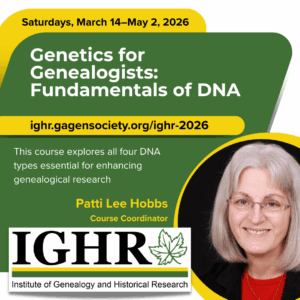
Genetics for Genealogists: Fundamentals of DNA
- Registration ended on March 11 at 11:59 p.m.
- Classes began at 11 a.m. Eastern on Saturday, March 14, 2026 and met once a week each Saturday through May 2, 2026 (7 weeks total, skipping April 4, 2026)
- Cancellation Deadline: February 21, 2026
- Tuition: $545. Georgia Genealogical Society (GGS) members receive $50 discount.
About the Course
- Pre-sessions will be sent out by invitation from the coordinator
- Maximum: 35 students
- Virtual classrooms using Zoom
- Lectures will be recorded and available to view for one month after the end of the course
- All courses come with a digital syllabus
- Students will receive a digital certificate upon course completion
Course faculty
Description
Discover the potential of using DNA testing in genealogy. This course explores all four DNA types essential for enhancing genealogical research. Structured sessions will instruct about Y DNA, mitochondrial DNA, X DNA, and autosomal DNA; while practical exercises and case studies provide hands-on experience in integrating DNA evidence into family studies. The importance of correlating DNA with documentary evidence to reach more accurate genealogical conclusions is emphasized. Sessions incorporating the use of DNA tools will help students learn to identify, categorize, and correlate matches. The weekly class format allows for practice between sessions to solidify concepts. Office hours planned midway between regular class sessions offer assistance in practical application as well as theoretical understanding.
Prerequisites, textbooks, and other student information
Course prerequisites:
There are no DNA education prerequisites for this beginner course. Attendees should be familiar with genealogical research concepts and techniques taught in IGHR’s Methods and Sources in Practice (Core Course 1) and Intermediate Genealogy and Historical Studies (Core Course 2).
There will be pre-sessions that will be available to provide an overview of the various testing websites.
Course requirements:
-
- Attendees should have taken DNA tests with AncestryDNA, FamilyTreeDNA (Family Finder), and MyHeritage. Previously completed data transfers to these companies are fine, but more recently problems are often encountered with transfer attempts. Taking the test is preferred. Watch for sales.
- An additional monitor for side-by-side viewing of material is highly recommended.
- Basic proficiency using spreadsheets is helpful although extra assistance will be provided when needed.
Required books:
None
2026 Course Schedule (All times listed are Eastern Time)
| Saturday, March 14, 2026 – Week 1 | ||
| 11:00 – 12:00 | Genetics for Genealogists Intro (Hobbs) | |
| 12:00 – 12:15 | Break | |
| 12:15 – 1:30 | Patrilineal Lines: Y-DNA, Part 1 (Hobbs) | |
| 1:30 – 2:30 | Lunch | |
| 2:30 – 3:45 | Patrilineal Lines: Y-DNA, Part 2 and Mitochondrial DNA (Hobbs) | |
| 3:45 – 4:00 | Discuss homework assignment (Hobbs) | |
| Saturday, March 21, 2026 – Week 2 | ||
| 11:00 – 11:30 | Review Y-DNA and mt-DNA Exercises (Hobbs) | |
| 11:30 – 12:45 | Autosomal DNA Fundamentals (Hobbs) | |
| 12:45 – 1:00 | Break | |
| 1:00 – 2:15 | The Power of Combining Shared Relatives, Shared DNA, and Pedigrees to Identify Unknown Relatives (Taplin) | |
| 2:15 – 3:15 | Lunch | |
| 3:15 – 4:00 | Case Study Exercise for Autosomal DNA: Combining Shared Relatives, Shared DNA, and Pedigrees, drawing tools (Hobbs) | |
| Saturday, March 28, 2026 – Week 3 | ||
| 11:00 – 12:15 | Homework review, Understanding X DNA (Hobbs) | |
| 12:15 – 12:30 | Break | |
| 12:30 – 1:45 | Autosomal DNA: Clustering (Taplin) | |
| 1:45 – 2:45 | Lunch | |
| 2:45 – 4:00 | Hands-on Session – Leeds Method (Taplin) | |
| Skipping April 4, 2026 – no class | ||
| Saturday, April 11, 2026 – Week 4 | ||
| 11:00 – 12:15 | Building Match Trees to Solve DNA Problems (Powell) | |
| 12:15 – 12:30 | Break | |
| 12:30 – 1:45 | Tangled Trees: Navigating Endogamy (Powell) | |
| 1:45 – 2:45 | Lunch | |
| 2:45 – 4:00 | Autosomal DNA: Segments and Triangulation (Hobbs) | |
| Saturday, April 18, 2026 – Week 5 | ||
| 11:00 – 12:15 | DNA Segments and Triangulation: Using Company Tools (Hobbs) | |
| 12:15 – 12:30 | Break | |
| 12:30 – 1:45 | GEDmatch (Hobbs) | |
| 1:45 – 2:45 | Lunch | |
| 2:45 – 4:00 | DNA Painter and Hands-on Exercises (Hobbs) | |
| Saturday, April 25, 2026 – Week 6 | ||
| 11:00 – 12:00 | Shared Matches and Triangulating Segments – applying methods and in-class practice, Part 1 (Hobbs) | |
| 12:00 – 12:15 | Break | |
| 12:15 – 1:15 | Part 2 (Hobbs) | |
| 1:15 – 2:15 | Lunch | |
| 2:15 – 3:15 | Part 3 (Hobbs) | |
| Saturday, May 2, 2026 – Week 7 | ||
| 11:00 – 12:15 | Statistics for Genetic Genealogy and Kinship Analysis, Admixture, and Biogeographical Analysis (Hobbs) | |
| 12:15 – 12:30 | Break | |
| 12:30 – 1:45 | Methodologies in Problem Solving with DNA (Hobbs) | |
| 1:45 – 2:45 | Lunch | |
| 2:45 – 4:00 | DNA and the Genealogical Proof Standard (Hobbs) | |
