

“Even though I expected this course to be excellent, it exceeded my expectations. The instructors were knowledgeable and well organized and the topics very, very helpful. I’ll be very busy using everything I learned. And the new format, which I was skeptical about, was perfect. Having a week between sessions to practice the info was terrific. I never felt overloaded, just empowered to do more. Bravo! Bravo! Every experienced genealogist should take this class. I’m recommending it to everyone.”
“Research places that I never thought of. I will spend my weekend searching. Thank-you for the information on how & where to search.”
“Best session on organizing my research notes and recording all my searches I’ve ever heard – for some reason – this process finally makes sense!”
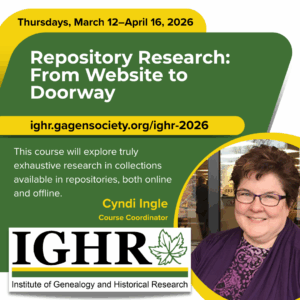
Repository Research: From Website to Doorway
- Registration began November 22, 2025
- Registration ended February 12, 2026 at 11:59 p.m. Eastern
- Classes began at 10:45 a.m. Eastern on Thursday, March 12, 2026 and met once a week each Thursday through April 16, 2026 (6 weeks total)
- Three lectures per day, plus a class working hour at the end of each day for applying what is newly learned, to ask questions, and to interact with students and instructors.
- Cancellation Deadline: February 19, 2026
- Tuition: $545. Georgia Genealogical Society (GGS) members receive $50 discount.
About the Course
- Maximum: 40 students
- Virtual classrooms using Zoom
- Lectures will be recorded and available to view for one month after the end of the course
- All courses come with a digital syllabus
- Students will receive a digital certificate upon course completion
Course Faculty
- Cyndi Ingle, Course Coordinator
- Amy E. K. Arner, CG®
- Kimberly T. Powell, AG®
- Patricia Walls Stamm, CG®, Retired
- Paula Stuart-Warren, CG®, FMGS, FUGA
- Cari A. Taplin, CG®
- Ari Wilkins, FTxSGS
Description
The 21st century genealogist starts with research online, exhausting all resources available on the Internet before stepping foot in brick-and-mortar buildings. But are they truly getting everything they need in their time online when it comes to research in libraries, archives, and museum collections? The website is the virtual front door to research repositories and once through that door, researchers should eke out every detail they can to learn what is available, how to locate things, how to educate themselves about the repositories, and how to get the most from using them. From websites to catalogs to finding aids, this course will explore what it means to do truly exhaustive research in the wide array of collections available in repositories, both online and offline.
Rationale for the Course Creation
Today’s online genealogists need the tools to make proper use of research repositories. The Internet makes it possible for genealogists to research from afar, particularly when travel to in-person venues is hard to do because of time, distance, expense, personal health issues, or disabilities. They can gain a similar kind of knowledge and learning experience given to anyone who does in-person research. If all researchers today start with the Internet, then the education for the use of repositories needs to start by teaching researchers how to use repositories from the website to the doorway.
Course Objectives and Expectations
We will explore a variety of repositories, how to find them, how to use them, how to use the tools made for them, and how to communicate with them. The expectation is for students to feel confident in making use of research repositories from a distance, with help from the librarians or archivists, or local professionals. And to also feel confident using them once they are finally able to visit those repositories themselves.
Prerequisites, textbooks, and other student information
Course prerequisites:
A basic understanding of genealogical research in records and sources.
Course requirements:
Students should feel comfortable navigating websites and using multiple browser windows and tabs at a time.
2026 Course Schedule (All times listed are Eastern Time)
| Thursday, March 12, 2026 – Week 1 | ||
| 10:45 – 11:00 | Introduction (Ingle) | |
| 11:00 – 12:15 | Searching Repository Websites and Collections (Ingle) | |
| 12:15 – 12:30 | Break | |
| 12:30 – 1:45 | Navigating Repository Websites: The Power of Browsing (Ingle) | |
| 1:45 – 2:45 | Lunch | |
| 2:45 – 4:00 |
From Questions to Discoveries: Crafting Effective Research Plans (Powell)
|
|
| 4:00 – 5:00 | Class Application Time | |
| Thursday, March 19, 2026 – Week 2 | ||
| 11:00 – 12:15 |
Understanding the Value of University Archives and Special Collections (Arner)
|
|
| 12:15 – 12:30 | Break | |
| 12:30 – 1:45 | Manuscript Collections and the Stories They Tell (Powell) | |
| 1:45 – 2:45 | Lunch | |
| 2:45 – 4:00 | Building A Locality Guide: Focus on Repositories (Taplin) | |
| 4:00 – 5:00 | Class Application Time | |
| Thursday, March 26, 2026 – Week 3 | ||
| 11:00 – 12:15 |
Navigating the U.S. National Archives: A Research Roadmap (Powell)
|
|
| 12:15 – 12:30 | Break | |
| 12:30 – 1:45 | Traveling Outside of Washington for an Assortment of NARA Records (Stamm) | |
| 1:45 – 2:45 | Lunch | |
| 2:45 – 4:00 | Federal Depository Library Untapped Resources for the US Executive Branch (Stamm) | |
| 4:00 – 4:15 | Break | |
| 4:15 – 6:00 | Underutilized Legislative Resources within a Federal Depository Library (Stamm) | |
| Thursday, April 2, 2026 – Week 4 | ||
| 11:00 – 12:15 | Maximizing Your Research in a Public Library (Wilkins) | |
| 12:15 – 12:30 | Break | |
| 12:30 – 1:45 | Black and White Families in Southern Plantation Records: A Case Study (Wilkins) | |
| 1:45 – 2:45 | Lunch | |
| 2:45 – 4:00 |
Genealogical Society Libraries: Views of Them from Both Sides (Stuart-Warren)
|
|
| 4:00 – 5:00 | Class Application Time | |
| Thursday, April 9, 2026 – Week 5 | ||
| 11:00 – 12:15 | Library of Congress and Other National Libraries (Ingle) | |
| 12:15 – 12:30 | Break | |
| 12:30 – 1:45 |
State Archives in the U.S.: Beginnings, Growth, and Today (Stuart-Warren)
|
|
| 1:45 – 2:45 | Lunch | |
| 2:45 – 4:00 | Hiring Help from Afar (Taplin) | |
| 4:00 – 5:00 | Class Application Time | |
| Thursday, April 16, 2026 – Week 6 | ||
| 11:00 – 12:15 | Locating Religious and Ethnic Collections in Repositories (Ingle) | |
| 12:15 – 12:30 | Break | |
| 12:30 – 1:45 | Genealogical Grit: Persevering Through Problems (Taplin) | |
| 1:45 – 2:45 | Lunch | |
| 2:45 – 4:00 | Case Studies in Using Record Repositories (Arner) | |
| 4:00 – 5:00 | Class Application Time, Closing Comments, Certificates | |
